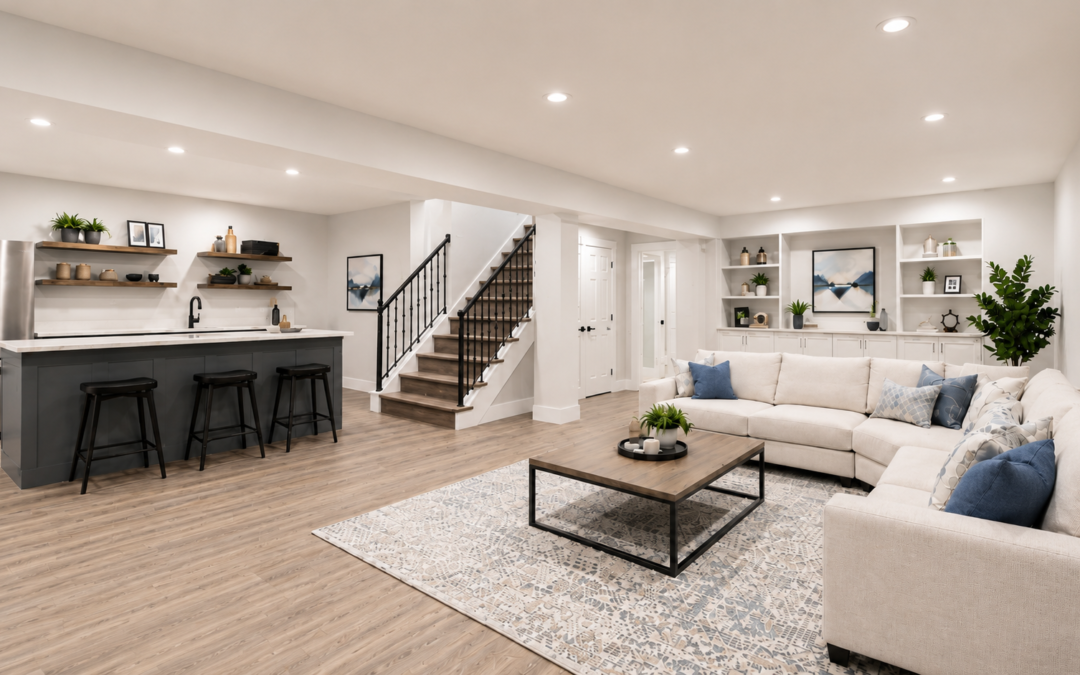
How to light a basement that has little or no daylight — choosing the right Kelvin, why high CRI matters underground, layering fixtures, and planning for emergencies.
Table of Contents
- Why Basement Lighting Is Different
- Choosing the Correct Color Temperature
- Why High CRI Matters Even More Underground
- Layer Your Lighting: Ambient, Task, and Accent
- Basement Fixtures to Consider
- Ultra-Slim Wafer Recessed Lights
- Recessed Downlights (Selectable CCT / Dim-to-Warm)
- Adjustable / Gimbal Trims for Accent
- RGBW Color-Changing Slim Lights
- Smart Controls, Sensors, and Automation
- Motion and Occupancy Sensors: No More Dark Stairs
- The Westgate Smart App
- Automation and Scenes
- Smart Controls and Energy Efficiency
- Don’t Forget Emergency and Exit Lighting
- Lighting by Basement Use
- Plan Your Layout: Free DIY Tool or Professional Design
- Bringing Your Basement Lighting Together
- Frequently Asked Questions
- What color temperature is best for a basement?
- What CRI should I look for in basement lighting?
- How many recessed lights do I need in my basement?
- Do I really need emergency lighting in a basement?
- Can my basement lights turn on automatically when I walk down?
- What lighting works best for a low basement ceiling?
Summary: Key Takeaways
- Basements get little or no daylight, so artificial lighting does all the work — the right choices completely change how the space feels.
- Color temperature (measured in Kelvin) sets the mood: warm light (2700–3000K) for relaxing zones, neutral to cool (3500–5000K) for tasks.
- Because there is no daylight to correct color, high CRI (90+) matters even more underground — it keeps skin tones, finishes, and décor looking natural.
- Layer ambient, task, and accent lighting, and favor slim, low-profile fixtures that preserve precious basement headroom.
- Windowless basements need a plan for power outages: emergency lights and exit signs lead people safely to the stairs when the lights go out.
- Smart controls earn their place: motion sensors light the stairs hands-free, and an app, scheduling, and sensors cut wasted energy.
- You can lay out fixtures yourself with a free DIY tool or submit your plans for a free, professionally engineered lighting design.
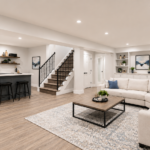
Lighting is the single biggest factor in how a finished basement feels, and it is also the one most people underestimate. Upstairs, windows do much of the work; below grade, there is often little or no natural light, so your fixtures carry the entire load — setting the mood, making colors look right, and keeping the space safe to move through. Get the lighting right and a basement feels like a true extension of the home. Get it wrong and even a beautifully finished room can feel like a dim, cave-like afterthought.
This guide covers the decisions that matter most: choosing the correct color temperature, why a high color-rendering index (CRI) is so important underground, how to layer fixtures, how smart controls and sensors add convenience and energy savings, and why a windowless basement needs emergency lighting. Throughout, we point to specific fixtures from Westgate Manufacturing’s residential lighting line, and we finish with free tools to plan your layout. For the rooms themselves, pair this with our basement design ideas guide.
Why Basement Lighting Is Different
A basement presents lighting challenges no other room does. There is usually minimal daylight, ceilings tend to be lower, and ductwork or beams can intrude on the space. Three principles follow from that:
Artificial light is the only light. With few or no windows, your fixtures define the entire visual experience — quality matters more here than anywhere else in the house.
Headroom is precious. Low ceilings favor slim, recessed, and low-profile fixtures that light the room without eating into clearance.
One room, many uses. Basements often combine lounging, working, and playing, so flexible, dimmable, and selectable-color lighting earns its keep.
Choosing the Correct Color Temperature
Color temperature describes how warm or cool a light appears, measured in Kelvin (K). Lower numbers look warm and amber; higher numbers look cool and blue-white. It has nothing to do with brightness — two lights can be equally bright but feel completely different. In a basement, color temperature is your main tool for setting the mood of each zone.
| Color Temp | Appearance | Best Basement Use |
|---|---|---|
| 2700K | Warm white (cozy, amber) | Home theater, lounge, bedroom |
| 3000K | Soft warm white | Living areas, bar, relaxed spaces |
| 3500K | Neutral white | Multipurpose rooms, hallways, stairs |
| 4000K | Cool/neutral white | Kitchenette, office, gym, laundry |
| 5000K | Daylight (crisp, energizing) | Workshop, storage, task-heavy areas |
As a rule of thumb, use warm light where you want to relax and cooler light where you need to focus. Mixing temperatures across zones is fine — a warm theater corner can sit a few feet from a neutral kitchenette — as long as each zone is internally consistent.
Selectable-CCT and Dim-to-Warm Fixtures
If you are unsure, selectable color-temperature fixtures take the guesswork out. Many Westgate residential fixtures use a Multi-CCT (MCT5) switch that lets you choose among five color temperatures (typically 2700K to 5000K) right at installation — or change it later if a room’s use changes. For lounges and theaters, dim-to-warm fixtures are even nicer: like a traditional bulb, they shift warmer as you dim them, so movie night glows instead of going gray. Westgate’s recessed downlight series and dim-to-warm options are good places to start.
Why High CRI Matters Even More Underground
Color Rendering Index (CRI) measures how accurately a light source shows colors compared with natural daylight, on a scale from 0 to 100. Under low-CRI light, reds turn muddy, skin looks sallow, and wood tones and paint colors read wrong. Standard LEDs are often around 80 CRI; high-quality fixtures reach 90 or above.
Here is the key point for basements: upstairs, daylight constantly “corrects” how colors look, so a mediocre CRI is forgiving. In a windowless basement there is no daylight to fall back on — your LEDs are the only thing rendering color, all day and night. That makes a high CRI more important below grade than almost anywhere else. For finished basements, aim for 90+ CRI, and pay attention to the R9 value (deep reds), which strongly affects how natural skin tones and warm woods appear.
Many Westgate residential LED fixtures are available in 90+ CRI versions — worth confirming on the spec sheet for any series you choose from their residential lighting catalog.
Layer Your Lighting: Ambient, Task, and Accent
Professional lighting design rarely relies on a single source. Instead it builds three layers that work together, which is exactly what a multi-use basement needs.
| Layer | Purpose | Good Westgate Fixture Types |
|---|---|---|
| Ambient | Overall, even fill light | Ultra-slim wafer recessed lights; recessed downlights |
| Task | Focused light for activities | Adjustable downlights; higher-output recessed over work zones |
| Accent | Highlight features and add mood | Adjustable/gimbal trims; RGBW color-changing slim lights |
Start with ambient light spaced evenly across the ceiling, then add task light where people read, cook, or game, and finally accent light to highlight a bar, artwork, or a display niche. Adjustable gimbal trims aim light exactly where you want it, while color-changing RGBW fixtures are perfect for game rooms and theaters where the mood shifts. Put each layer on its own dimmer or switch so one room can flex from bright and practical to soft and cinematic.
Basement Fixtures to Consider
These Westgate residential fixture families suit the realities of a basement — low ceilings, no daylight, and many uses. Product photos can be requested from Westgate; each placeholder below is labeled with the series to drop in.
Ultra-Slim Wafer Recessed Lights
Wafer-style recessed lights install in a shallow ceiling cavity, which makes them ideal where ductwork and low joists limit depth. Westgate’s ultra-slim recessed series comes with selectable color temperature and 90+ CRI options, delivering clean, even ambient light with a minimal footprint.
Recessed Downlights (Selectable CCT / Dim-to-Warm)
For a more substantial downlight with the same flexibility, Westgate’s recessed downlight series offers Multi-CCT selection, while the dim-to-warm versions glow warmer as they dim — perfect for lounge and theater zones.
Adjustable / Gimbal Trims for Accent
To highlight a feature wall, bar, or artwork, adjustable recessed trims tilt and rotate to aim light precisely, adding depth and drama beyond flat ambient light.
RGBW Color-Changing Slim Lights
For game rooms, home theaters, and bars that want a show, RGBW color-changing recessed lights deliver tunable color plus quality white light in one slim fixture — bright and neutral for play, saturated color for movie night or parties.
Smart Controls, Sensors, and Automation
The fixtures are only half the story — how you control them is what makes a basement genuinely easy to live with. Smart controls and sensors solve two problems unique to below-grade spaces: reaching for a switch at the top of a pitch-black staircase, and lights left burning for hours in a room no one is using.
Motion and Occupancy Sensors: No More Dark Stairs
An occupancy sensor is the single most useful lighting upgrade for a basement. It detects motion and switches the lights on automatically as you approach the top of the stairs — no fumbling for a switch in the dark with your arms full of laundry or boxes — then turns them off on an adjustable delay once the space is empty. For a windowless basement, that hands-free “light the way down” behavior is both a safety and a convenience win.
Westgate’s lighting controls include PIR (passive-infrared), microwave, and dual-technology occupancy and vacancy sensors, plus sensor wall switches, for exactly this job. A few placement tips:
Top and bottom of the stairs so the path lights up before you take a step.
Storage, laundry, and utility areas where lights are most often left on by accident.
Occupancy vs. vacancy: occupancy sensors switch on automatically (best for stairs and hands-full moments), while vacancy sensors turn on manually but shut off automatically for maximum savings.
The Westgate Smart App
Westgate’s smart fixtures and controls connect to the free Westgate Smart app for iOS and Android, over Bluetooth nearby or Wi-Fi from anywhere. For a basement, the standout features are:
Remote control — flip the basement lights on from your phone before you head down, so you never walk into a dark room.
Dimming and color changing — set the tone for movie, game, or work mode without getting up.
Scheduling — automate routines, such as a low stair light every evening or an all-off at bedtime.
Voice control — use Amazon Alexa or Google Assistant for hands-free “turn on the basement.”
Bluetooth mesh — reliably control a larger finished basement across multiple zones.
Automation and Scenes
Combine sensors, schedules, and app scenes and the basement starts to run itself. A single tap or voice command can dim the theater corner, switch the RGBW lights to a movie tone, and shut off the rest of the room; a stair light can come on automatically at dusk; and everything can power down when the last person leaves. The color-changing and dim-to-warm fixtures covered earlier are app-controllable, so they slot straight into these scenes.
Smart Controls and Energy Efficiency
This is where smart controls pay for themselves. Basements are full of set-and-forget spaces — storage, laundry, a guest room used twice a year — where lights routinely burn for hours with no one there. Occupancy and vacancy sensors make sure lights are on only when a room is in use, scheduling prevents all-night runs, and dimming trims wattage. Automatic shutoff and occupancy sensing are core strategies in modern energy codes such as ASHRAE 90.1 and California’s Title 24, and pairing efficient LEDs with controls is exactly the approach ENERGY STAR recommends for cutting lighting energy use.
One caveat worth knowing: motion sensors and app controls run on your home’s power, so they make everyday life easier but do not help during an outage. For that you still need battery-backed emergency lighting — which is next.
Don’t Forget Emergency and Exit Lighting
This is the safety point most basement guides skip. Many basements are completely windowless, which means that if the power goes out, the space goes pitch black — there is no moonlight, streetlight, or dawn to help. Anyone in the basement, including children or guests who do not know the layout, can be left disoriented at the top of a staircase in total darkness. That is exactly the situation emergency lighting is built for.
Why a windowless basement needs emergency lighting
- Emergency lights contain a battery that automatically powers the fixture when the main power fails, illuminating the path to the stairs.
- Exit signs clearly mark the way out, which matters in a finished basement with several rooms or partitions.
- Combination units pair an exit sign with emergency heads in one device to do both jobs at once.
- Battery backup options can keep critical fixtures running for the code-required duration during an outage.
Westgate makes a full range of exit and emergency lighting, including exit signs, emergency lights, and combination units. A single-family basement may not be legally required to have emergency lighting, but the safety case for a windowless space is strong — and finished basement apartments, accessory dwelling units, and rentals often are required to illuminate the means of egress. The NFPA 101 Life Safety Code governs egress illumination, and your local building department has the final word, so confirm what applies to your project.
This pairs with the physical escape route: see the egress-window requirements in our basement design ideas guide for finished and sleeping rooms.
Lighting by Basement Use
Tune the layers and color temperature to each room’s purpose:
Home theater: warm 2700K, dim-to-warm recessed, low glare, plus subtle bias lighting behind the screen.
Game room: RGBW for mood plus bright neutral light for tabletop play, all on dimmers.
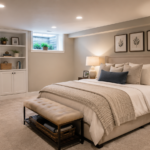
Bedroom or guest room: warm, layered light with bedside task lighting; keep it cozy and glare-free.
Home office: neutral 4000K, high CRI, and dedicated task light to fight eye strain where daylight is scarce.
Home gym: bright, even 4000–5000K so the space feels energizing and safe.
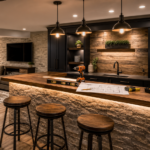
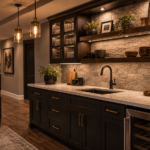
Kitchenette or bar: neutral ambient plus accent light on the counter and shelves; see our basement bar ideas for layout.
Stairs and hallways: even, shadow-free light for safe footing — and back it up with emergency lighting.
Flooring affects how light bounces, too: pale floors brighten a basement while dark floors absorb light. Our best flooring for basements guide can help you balance the two.
Plan Your Layout: Free DIY Tool or Professional Design
Good lighting is as much about placement and spacing as it is about the fixtures themselves. Too few lights leave dark spots; too many waste energy and flatten the room. You do not have to guess at the count and spacing — Westgate offers two free ways to get it right:
Two free ways to design your basement lighting
- DIY Lighting Tool — get an instant layout in minutes with no login required. Ideal for quick estimates and early planning. Start at westgatemfg.com/lighting-design/diy-lighting-tools.
- Free Professional Design — submit your plans (site photos, room dimensions, or the project address) and Westgate’s lighting engineers will create a custom, code-aware layout tailored to your space, at no cost. Request one at westgatemfg.com/lighting-design/custom-lighting-layout.
Not sure which to pick? Start with the DIY tool and upgrade to a professional design anytime. Both are reachable from the main Westgate lighting design page.
Professional layouts follow recognized standards — such as the Illuminating Engineering Society (IES) recommendations for light levels — so each area gets the right amount of light for how it is used. And because a basement build adds circuits, have a licensed electrician handle the wiring to the National Electrical Code, including GFCI protection for basement receptacles.
Bringing Your Basement Lighting Together
In a space with little or no daylight, lighting is not a finishing touch — it is the foundation of how the room looks and feels. Choose a color temperature that fits each zone, insist on high CRI so colors look true, layer ambient, task, and accent light on dimmers, and protect everyone with emergency lighting in case the power fails. Plan the layout with a free tool or a professional design, and your basement will be bright, comfortable, and safe from the first switch you flip.
Frequently Asked Questions
What color temperature is best for a basement?
It depends on the zone. Use warm 2700–3000K for relaxing areas like a theater, lounge, or bedroom, and neutral to cool 3500–5000K for tasks in a kitchenette, office, gym, or workshop. Selectable-CCT fixtures let you choose or change later.
What CRI should I look for in basement lighting?
Aim for 90+ CRI. Because a basement has little or no daylight to correct color, high CRI keeps skin tones, wood, paint, and décor looking natural. Also check the R9 (deep red) value for the most accurate warm tones.
Note: lighting choices affect comfort and safety. The recommendations here are general guidance; have a licensed electrician handle wiring and confirm any code requirements with your local building department.
How many recessed lights do I need in my basement?
It depends on room size, ceiling height, fixture output, and use. Rather than guess, use a free DIY lighting tool for a quick layout, or submit your dimensions for a free professional design that spaces fixtures for even, code-aware coverage.
Do I really need emergency lighting in a basement?
If your basement is windowless, it is strongly recommended: a power outage leaves it completely dark with no path to the stairs. Single-family homes may not be required to install it, but basement apartments, ADUs, and rentals often must illuminate the means of egress — check NFPA 101 and your local code.
Can my basement lights turn on automatically when I walk down?
Yes. An occupancy (motion) sensor turns the lights on automatically as you reach the stairs and off after you leave, so you are never feeling for a switch in the dark. You can also flip them on from your phone with the Westgate Smart app before you head down, or use an Alexa or Google voice command.
What lighting works best for a low basement ceiling?
Ultra-slim wafer recessed lights are ideal because they install in a shallow cavity and sit flush, lighting the room without reducing headroom. Pair them with adjustable trims for accents where needed.
Keep planning your basement with our related guides:
basement design ideas, best flooring for basements, and basement bar ideas.